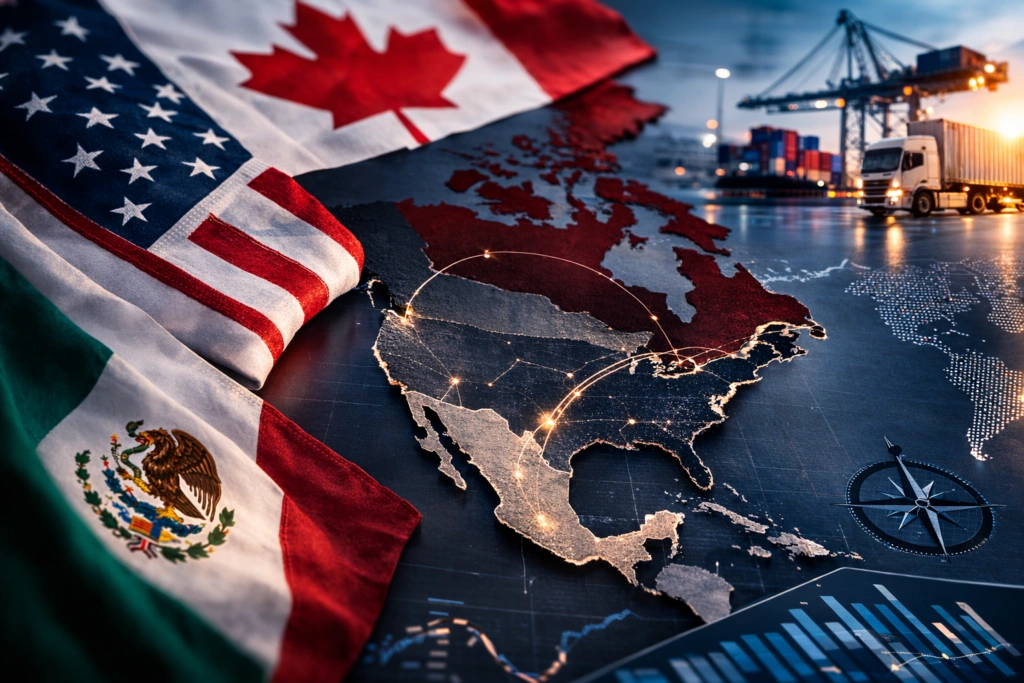
“There can be a maximum of 10 annual reviews, which takes you to 2036. If by 2036 we have not achieved it, then yes, in that year the legal instrument that is the USMCA would cease to exist,” Baker explained.
By Héctor Usla
May 28, 2026 | 1:34 PM
The review of the United States-Mexico-Canada Agreement (USMCA) could lead to a period of up to 10 years of annual reviews if the three countries fail to reach a comprehensive agreement by 2026, a scenario that would prolong uncertainty for strategic sectors such as automotive and manufacturing, warned Juan Carlos Baker, CEO of Ansley International Consultants and former Undersecretary of Foreign Trade.
During his participation in the El Financiero Meet Point Virtual forum, the specialist explained that, although the business and political sectors have adopted July 1, 2026, as a key date for the review of the trade agreement, the treaty includes flexibility provisions that could extend the process for several years.
“If we can’t reach an agreement this year, the treaty isn’t going to die; we’re not going to return to trade outside the USMCA regulations the next day,” Baker stated.
The former USMCA negotiator explained that Article 34.7 of the agreement establishes that the review must be carried out six years after its entry into force, which occurred on July 1, 2020; however, he clarified that there is no obligation to conclude the process on that specific date.
If no consensus is reached by 2026, the treaty could enter a process of successive annual reviews until 2036.
“There can be a maximum of 10 annual reviews, which takes you to 2036. If we haven't reached an agreement by 2036, then yes, in that year the legal instrument that is the USMCA would cease to exist,” he explained.
Baker acknowledged that this scenario would be especially challenging for companies that rely on clear rules to make long-term investment decisions.
“It’s certainly exhausting, and it won’t help with the uncertainty, nor will it help with the certainty,” he noted.
The specialist indicated that, although the ideal scenario would be an early renewal of the treaty for another 16 years, there are signs that the negotiations could be more complex than anticipated.
“We would love for there to be a major event on July 1st where the leaders of the three countries are present and officially announce the renewal of the treaty for another 16 years. However, it is possible that this will not happen,” he commented.
The uncertainty surrounding the future of the USMCA comes at a particularly sensitive time for Mexico, due to trade tensions with the United States, including the automotive tariffs imposed under Section 232 for national security reasons.
Several specialists and industry representatives have warned that a prolonged trade uncertainty could affect investment decisions related to nearshoring, as well as the expansion of manufacturing supply chains in Mexico.
https://www.elfinanciero.com.mx/economia/2026/05/28/t-mec-podria-entrar-en-una-decada-de-revisiones-anuales-y-tener-ventaja-en-inversiones-juan-carlos-baker/
.png)