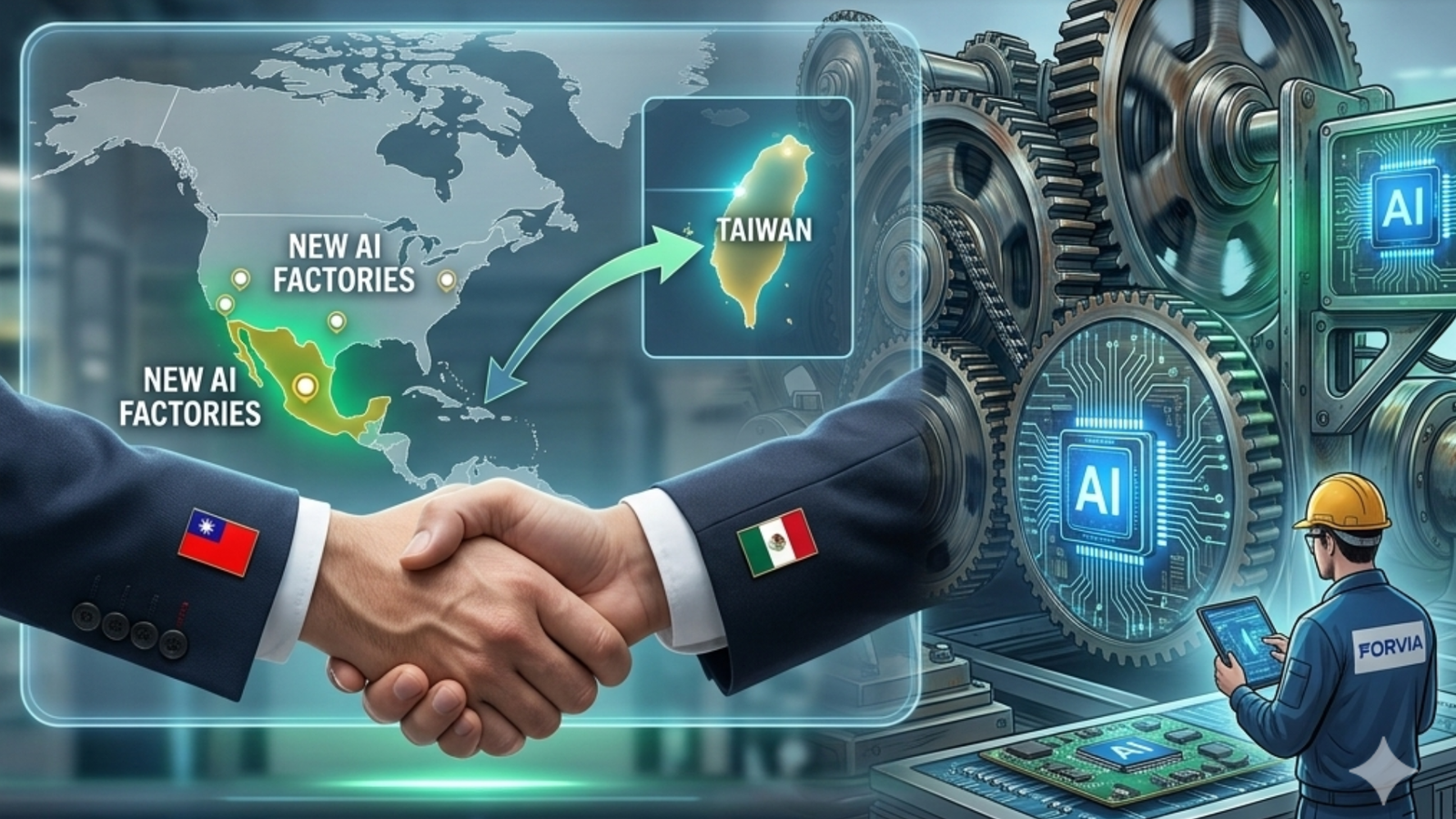
Taiwanese technology corporations are accelerating manufacturing expansions in Mexico to secure North American supply chains amid an AIe infrastructure boom. While export metrics indicate structural growth, emerging regional electricity and water constraints across industrial hubs present significant operational challenges for long-term capacity scaling.
At least eight Taiwanese technology corporations have initiated operational setups in Mexico over the last two years to scale manufacturing capacity for advanced electronics, automotive components, and AI infrastructure, reports AccessBridge. This strategic relocation stems from a structural realignment of global trade, where nearshoring allows manufacturers to bypass geopolitical friction and secure access to the North American market.
“Mexico clearly is a fundamental partner for them, because it allows them to scale production that they perhaps previously did in Asia, or in China, or in other Asian countries, but now due to market conditions, geopolitics, they need a partner that allows them to keep scaling," says Edgar Braham-Herrera, Managing Partner, AccessBridge International.
The acceleration of Taiwanese investments aligns with a transformation in Mexico’s export profile. According to an analysis by Gabriela Siller, Director of Economic and Financial Analysis, Banco Base, national exports reached US$664.8 billion in 2025. Computer equipment under tariff category 8471 emerged as the primary export engine, surpassing the automotive industry for the first time. This segment generated US$85.4 billion, representing 12.85% of total exports and reflecting an annual growth rate of 144.81%, outpacing overall export growth of 7.64%.
Siller notes that escalating technology infrastructure expenditures in the US serve as the primary catalyst. In 2025, US data center investments reached US$102.2 billion, growing nearly 30% year over year due to cloud computing and Generative AI tools.
Mexican electronics face an average tariff of 0.45% in the United States, compared to over 10% for Chinese commodities. Production remains concentrated across five states: Chihuahua, Jalisco, Baja California, Tamaulipas, and Nuevo Leon, with Texas absorbing over two-thirds of shipments.
Siller highlights a gap between trade output and capital insertion, as foreign direct investment in the computing subsector totaled only US$631 million in 2025, representing 0.46% of national foreign direct investment. Sector employment grew by a modest 3.84% to slightly over 331,000 workers.
Plants operate near full capacity, with utilization reaching 99.5%, capping short-term expansion. Dependency remains high; an analysis by Banco Base indicates that a one percent increase in US gross domestic product generates a 7.54 percentage point increase in computer equipment exports from Mexico.
Regional Infrastructure Pressures Threaten Scalability
The influx of manufacturing operations and computing facilities has exposed severe limitations in regional resources, generating operational friction across key industrial corridors.
Since 2020, Queretaro has attracted more than US$12 billion investments from corporations including Microsoft, Google, and Amazon, establishing 12 operational data centers. This aligns with a federal strategy promoted by Mexican President Claudia Sheinbaum. In September 2025, CloudHQ announced a US$4.8 billion investment to construct six facilities by 2027, projecting 900 permanent jobs.
However, hyperscale cooling systems strain regional infrastructure. Local organizations like the National Antorchista Movement demand transparency from the state government, which exempts facilities within industrial parks from standard environmental impact reports. In nearby Viborillas, residents face strict water rationing, receiving access only three days a week.
Marco del Prete, Queretaro’s Minister of Sustainable Development, says that water scarcity predates data centers. Adriana Rivera, Director, Mexican Data Centre Association (MEXDC), adds that these facilities utilize high-efficiency cooling to minimize consumption. Nevertheless, research by Context indicates that water allocation metrics are routinely obscured by non-disclosure agreements.
Electrical infrastructure presents an identical bottleneck. The MEXDC projects national capacity to reach 1.5GW by 2030, consuming 5% of planned national energy expansion. Masheika Allgood, Founder, AllAI Consulting, states that a hyperscale facility requires power equivalent to an entire city, prompting CloudHQ to invest US$250 million in proprietary infrastructure.
Socioeconomic commitments face parallel delays. Microsoft projected its US$1.3 billion layout would generate 300,000 jobs, but 2025 metrics showed only 64 active employees at one facility. A late 2025 assessment by Context revealed that 19 of 21 community projects promised in 2022 by UN-Habitat and Microsoft remained incomplete.
Unprecedented Power Demands Surface in Jalisco
Jalisco faces parallel capacity pressures. Flex, an electronic manufacturing corporation employing 40,000 people across eight domestic plants, announced a US$1 billion expansion in 2026, following US$2.3 billion invested over previous years.
Guillermo del Río, Director of Business Development and Government Relations, Flex, reported on April 16, 2026, during a press conference with President Sheinbaum, that the capital will fund data center components and AI servers.
This manufacturing requires unprecedented energy. Del Río says that the plant will consume 220MW, equivalent to seven times the electricity demand of the Port of Manzanillo, which handled 3.89 million TEUs in 2025. Specifically, server testing alone requires over 115,000W.
This demand, alongside unexecuted plans by Foxconn to construct an AI superchip plant in Guadalajara, necessitates grid guarantees.
Pablo Lemus, Governor of Jalisco, and Emilia Esther Calleja, Director, Federal Electricity Commission, pledged on May 25, 2026, to guarantee industrial electrical supply, while initiatives like a new laboratory inaugurated by Tere Jiménez, Governor of Aguascalientes, aim to secure the human capital pipeline.
https://mexicobusiness.news/cloudanddata/news/taiwans-tech-giants-bet-big-mexican-ai-manufacturing