Mexico’s aerospace industry is preparing for a new phase in North American trade relations as companies adapt to the ongoing review of the United States-Mexico-Canada Agreement (USMCA) and the impact of US tariffs on steel, aluminum and derivative products. In an interview with A21, Luis Lizcano, CEO, Mexican Federation of the Aerospace Industry (FEMIA), said companies should focus on adapting to the evolving trade environment rather than expecting a return to previous conditions.
The USMCA review has become one of the most significant issues facing the aerospace sector in 2026. Although July 1 was initially established as the target date for concluding the review process, Mexico’s Ministry of Economy announced that negotiations had been extended through the week of July 20 following discussions among the three member countries.
“Rather than looking back nostalgically to a period without tariffs, we need to focus on understanding how to operate under these new rules imposed by global economies, how to adapt to them, how to benefit from them and how to compete more effectively,” Lizcano said.
For the aerospace industry, tariffs on aluminum, steel and derivative products remain a major concern. According to the National Council of the Maquiladora and Export Manufacturing Industry (Index), these measures are generating an estimated US$7 billion impact on costs, operations, competitiveness and investment across Mexico’s export-oriented industries.
Mexico’s aerospace manufacturers are closely monitoring developments because of their deep integration with North American supply chains. The country primarily produces aircraft components that are exported for final assembly in international markets. The United States remains the sector’s principal destination, accounting for approximately 80% of aerospace exports, while Canada and European countries absorb the remaining 20%.
Industry representatives have also become actively involved in preparations for the USMCA review process. Mexico’s aerospace sector has formally joined working groups organized by the Ministry of Economy through the Cuarto de Junto, the private-sector advisory mechanism that supports the country’s trade negotiating team.
According to FEMIA, the objective is to ensure that technical priorities, sourcing requirements and supply-chain considerations are reflected in Mexico’s negotiating strategy. Preliminary consultations between government officials and industry representatives have already taken place as stakeholders evaluate potential changes to the agreement.
Lizcano said the industry expects a comprehensive review process but remains confident that the agreement will continue to support regional economic growth.
“We anticipate a very thorough review, but ultimately the USMCA will continue to be a driver of economic activity and growth for the aerospace sector,” he said.
Despite that expectation, uncertainty surrounding the review and broader trade policy developments has already influenced investment and production decisions. FEMIA estimates that aerospace exports reached approximately US$11 billion in 2025, reflecting continued expansion, albeit at a slower pace than in previous years.
The federation reported that the industry experienced annual growth rates of between 13% and 16% following the post-pandemic recovery. However, from January through June 2025, aerospace sales increased 9% year over year, signaling a deceleration that industry leaders attribute to trade tensions and pending policy decisions.
Earlier in 2026, FEMIA revised its growth outlook for the sector, projecting expansion of approximately 7%, compared with growth rates closer to 10% in prior years.
“Today, uncertainty remains the one constant not only for the aerospace industry but across virtually all economic sectors. Unfortunately, that negative factor continues to persist,” Lizcano said. He added that the outcome of the USMCA review could have important implications for industry activity.
“There are several challenges in the current environment. We have the imminent USMCA review, and depending on the outcome, it could affect the sector and its operations,” he said.
Mexico has become an increasingly important player in the global aerospace industry. According to FEMIA data, aerospace exports grew from US$6.7 billion in 2021 to US$10.7 billion in 2024, representing an increase of nearly 60% in three years. Industry estimates suggest exports may have exceeded US$13.6 billion in 2025 based on tariff classifications and trade data.
The country is currently the world’s twelfth-largest aerospace manufacturing hub and the fourth-largest exporter of aerospace products. The industry comprises 368 companies, up from approximately 100 firms in 2004. These manufacturers produce fuselage structures, electrical harnesses, avionics systems, turbine components and structural assemblies integrated into commercial, executive and military aircraft programs worldwide.
Foreign investment has played a central role in the sector’s expansion. Companies including Boeing, Airbus, Bombardier, Safran, Honeywell, GE Aerospace and RTX have established operations in Mexico, contributing to supplier development, technology transfer and workforce training. The United States accounts for approximately 48% of foreign direct investment in the sector, while France represents roughly 10%.
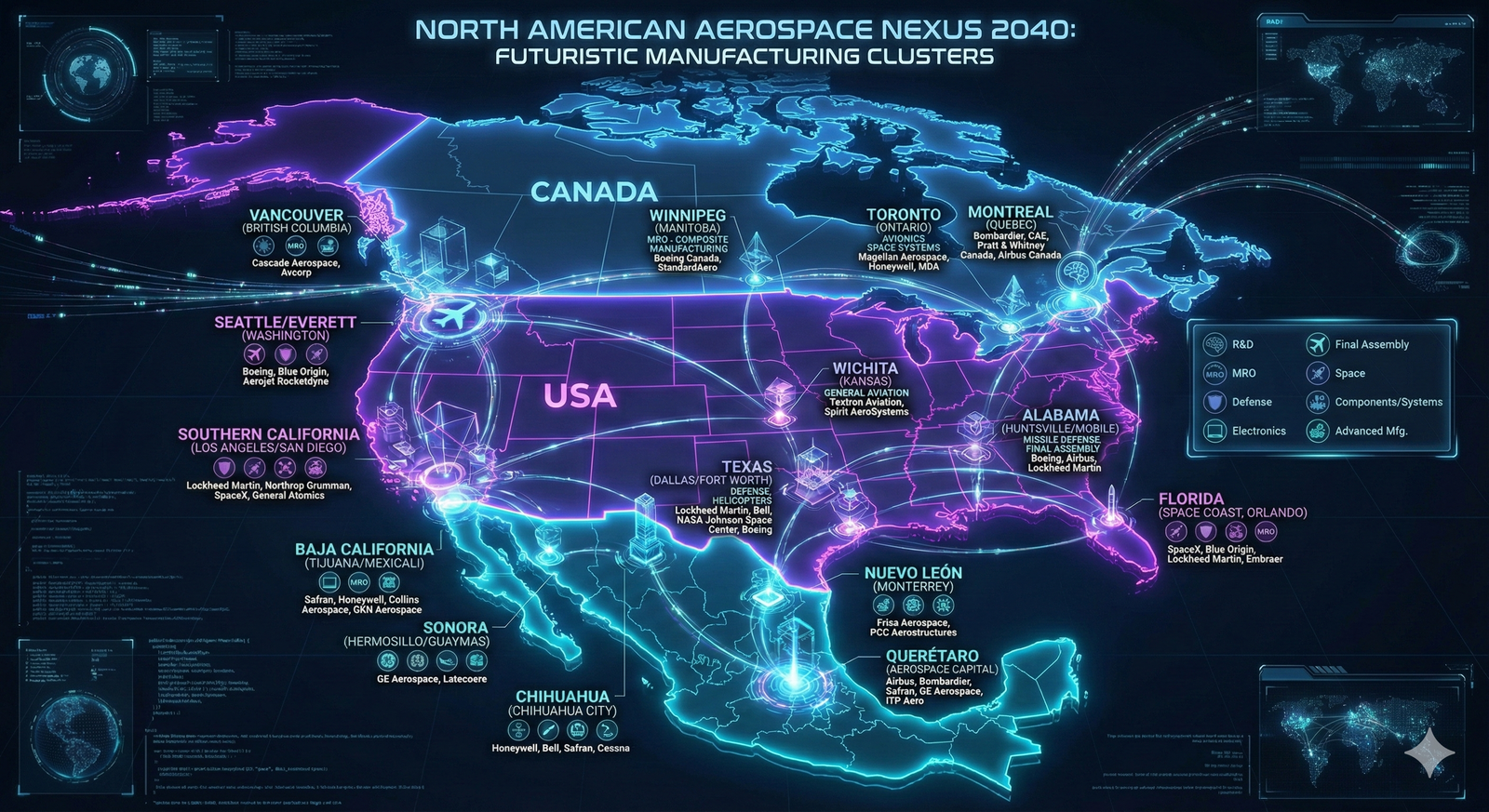
Regional aerospace clusters continue to strengthen Mexico’s manufacturing capabilities. Baja California specializes in precision machining and composite materials; Sonora focuses on avionics and engine components; Chihuahua produces structural assemblies; Queretaro serves as a center for engineering, maintenance, repair and overhaul (MRO) services; and Nuevo Leon is expanding its presence in advanced aerospace manufacturing.
At the same time, the industry is monitoring the possibility that future trade relations could include more frequent review mechanisms under the USMCA. Lizcano said annual or periodic reviews may become a permanent feature of the agreement.
“We do not know whether that will happen, but if it does, we must be prepared to adapt. Adaptation is essential because the best way to achieve success is by responding effectively to change,” he said.
https://mexicobusiness.news/aerospace/news/mexico-aerospace-adapts-usmca-review-tariffs-femia